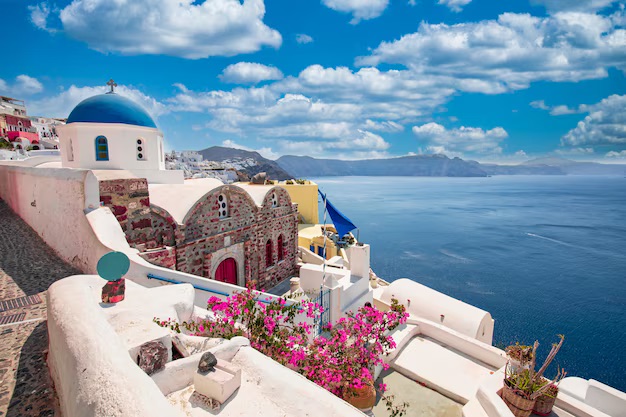
The Aegean is often introduced through maps: a scattered field of islands, narrow straits, rugged coastlines, and trading routes joining mainland Greece with Asia Minor, the Cyclades, Crete, and the wider eastern Mediterranean. Yet geography also helps explain something more immediate than politics or navigation: the food people cooked, carried, preserved, and shared.
Greek cuisine did not emerge from a single landscape. It developed across islands with limited farmland, mountain villages with difficult access to markets, coastal settlements connected by fishing and trade, and cities influenced by generations of migration. The familiar ingredients of a Greek table—olive oil, wheat, herbs, cheese, legumes, seafood, wine, and citrus—make more sense when viewed through that geographical history.
Islands, coasts, and the logic of preservation
For communities living close to the sea, fish was an everyday resource but also a practical challenge. Fresh catches were seasonal, weather-dependent, and perishable. Salting, drying, smoking, and cooking fish with olive oil, herbs, and acidic ingredients were ways to extend its usefulness and create distinctive local dishes.
The same pattern appears with vegetables. In places where soil was thin and water scarce, cooks relied on ingredients that travelled well through the seasons: beans, lentils, chickpeas, onions, wild greens, tomatoes, capers, and preserved olives. A meal built around legumes and olive oil was not originally a modern dietary trend. It was an adaptable answer to local conditions.
This is one reason Greek cooking is so varied despite sharing a recognizable identity. A coastal island dish may centre on octopus or small fish; a mountain village may favour slow-cooked beans, pies, goat cheese, and herbs. Both belong to the same culinary world, but each reflects a different geography.
Olive oil as landscape and trade
Olive trees have long shaped the visual and economic landscape of Greece. They tolerate dry summers better than many field crops and can thrive in rocky terrain where intensive agriculture is difficult. Their oil became essential not just for cooking, but also for lighting, religious practice, preservation, and commerce.
In the ancient Mediterranean, olive oil moved along the same maritime networks that carried pottery, textiles, wine, and ideas. Amphorae recovered from ports and shipwrecks testify to a connected world in which staple foods were also traded goods. The Aegean was never isolated; it was a crossroads.
That history remains visible in Greek food today. Olive oil is not merely an ingredient added at the end of a recipe. It is often the foundation of a dish, binding together vegetables, grains, seafood, cheese, and herbs. Its central role reflects climate, agriculture, exchange, and habit all at once.
The table as a social map
Food also reveals how communities organize time and relationships. In Greece, eating is traditionally social: dishes are placed in the centre of the table, shared over conversation, and enjoyed at a pace that makes room for company. The modern term meze is useful here, not simply as a menu category but as a style of gathering around several small dishes.
This shared-table tradition has travelled far beyond Greece. Greek communities abroad have adapted family recipes to new ingredients and new audiences while preserving the values behind them: generosity, seasonality, hospitality, and the pleasure of eating together.
For travellers, that cultural continuity can make Greek food one of the most accessible ways to understand a place. A plate of grilled fish, a village salad, stuffed grape leaves, or slow-cooked beans may look simple. But behind each dish is a long relationship between land, sea, trade routes, and family kitchens.
A Mediterranean tradition in Miami
The Aegean’s food culture now has a global life, including in coastal cities whose populations are shaped by migration and tourism. In South Florida, Greek cooking can be encountered not as a museum piece, but as a living tradition served to local residents and visitors.
For a current example of this continuity, visitors exploring Greek dining in Sunny Isles Beach can look at Mykonos Kitchen & Bar, a restaurant whose name and culinary focus draw on the island world that helped define the wider Aegean imagination.
The point is not that a Miami restaurant reproduces an ancient meal exactly. No cuisine stands still for centuries. Rather, it shows how food traditions survive by adapting—moving with people, taking root in new cities, and continuing to connect the everyday act of eating with the landscapes and stories from which those traditions began.